In 2025, Turkey exported over $282 million in children's apparel, cementing its position as one of Europe's most important sourcing destinations (TIM, 2025). Meanwhile, China continues to dominate global textile production with approximately 35% market share by volume (WTO, 2025). But volume alone does not guarantee the right sourcing decision — quality, compliance, lead times, and total cost of ownership are the factors that truly determine sourcing success. In this comprehensive guide, we compare Turkey and China across 10 critical criteria for children's clothing sourcing in 2026.
Key Facts
- Turkey children's apparel exports: $282M+ (2025, TIM)
- China global textile production share: ~35% (WTO, 2025)
- Turkey share of EU children's clothing imports: 12%+ (Eurostat, 2025)
- Turkey lead time: 4-8 weeks vs China: 8-16 weeks
- Turkey MOQ: 50-500 pieces vs China: 500-3,000 pieces
Turkey vs China: The 10-Criteria Comparison
The following table compares Turkey and China across the most important criteria for children's clothing sourcing:
| Criteria | Turkey | China |
|---|
| Lead Time | 4-8 weeks | 8-16 weeks |
| Minimum Order Quantity | 50-500 pieces | 500-3,000 pieces |
| Quality | Premium (EU standards built-in) | Variable (requires QC investment) |
| Certifications | GOTS, OEKO-TEX, SEDEX common | Available but less prevalent |
| Shipping to EU | 3-7 days (road/sea) | 25-40 days (sea freight) |
| Communication | English widely spoken | Language barrier common |
| Customs & Duties | EU Customs Union (0% tariff) | 12-17% EU tariff |
| Fabric Quality | Premium Turkish cotton | Mixed quality levels |
| Flexibility | High (small lot production) | Low (mass production focused) |
| Price | Medium-high | Low-medium |
As the table illustrates, both countries have distinct strengths. The right choice depends on your brand's priorities, target market, and business model.
When to Choose Turkey
Turkey provides clear advantages in children's clothing sourcing under the following scenarios:
- Quality-focused brands: Turkish manufacturers have decades of experience meeting EU standards including EN 14682 (cord safety), REACH chemical regulation, and the General Product Safety Directive (GPSD). Products are manufactured to EU specifications by default, eliminating the need for costly post-production adjustments.
- Small to medium order volumes: With MOQs starting as low as 50 pieces, Turkey enables new brands and boutique retailers to build collections without excessive inventory risk. This is particularly valuable for seasonal capsule collections and test runs.
- European market focus: The EU-Turkey Customs Union provides zero-tariff access for industrial goods including textiles. Compared to 12-17% duties on Chinese imports, this represents a significant cost advantage that often offsets higher FOB prices.
- Fast turnaround requirements: A 4-8 week production cycle combined with 3-7 day shipping means total lead time of 5-9 weeks — less than half of China's typical 10-20 week cycle. For fast-fashion and mid-season replenishment, this speed is invaluable.
- Organic and certified production: Turkey ranks in the global top 5 for organic cotton production. GOTS, OEKO-TEX, and SEDEX certified manufacturers are widely available, meeting the growing demand for sustainable and traceable supply chains.
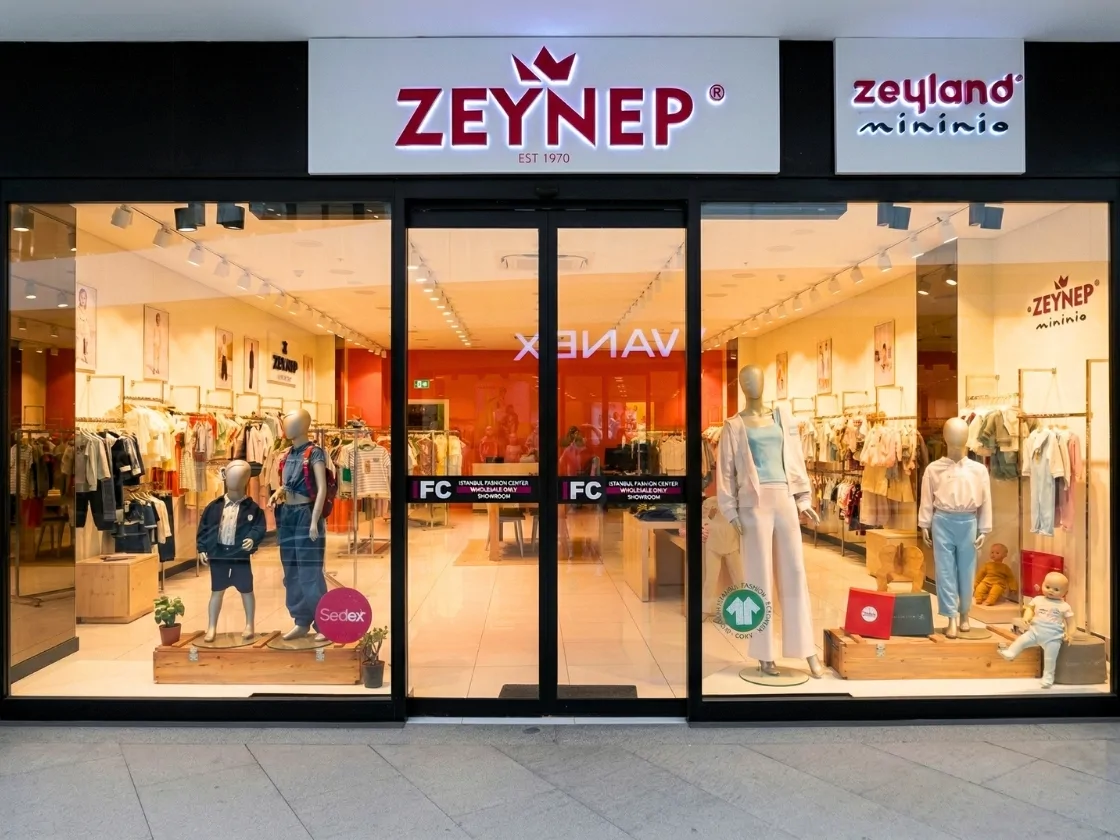
Zeynep Giyim exemplifies these Turkish advantages: GOTS, OEKO-TEX, and SEDEX certified with a monthly capacity of 90,000 pieces, specializing in children's clothing for ages 0-14. From small pilot runs to large-volume orders, Zeynep Giyim offers the flexibility and quality assurance that international buyers require.
When to Choose China
It would be unfair to overlook China's legitimate strengths. The following scenarios may favour Chinese sourcing:
- Very high volume orders: For orders exceeding 10,000 pieces, China's economies of scale can deliver unit costs 20-40% lower than Turkey. The sheer manufacturing infrastructure — with dedicated factories for every product category — enables aggressive pricing at volume.
- Basic commodity items: For plain t-shirts, simple pyjamas, and other items requiring minimal craftsmanship, China's cost advantage is most pronounced. The price gap narrows significantly for complex designs with embroidery, printing, or detailed finishing.
- Price-first market positioning: If your target consumer is highly price-sensitive and your brand positioning does not emphasize premium quality or sustainability, Chinese sourcing may be the more economical path.
- Specific materials and trims: For synthetic fabrics, zippers, buttons, and certain specialty materials, China offers both competitive pricing and extensive variety.
However, even in these scenarios, buyers must account for the total cost of ownership (TCO), not just the FOB price. Hidden costs can erode — or even eliminate — the apparent savings.
The Hidden Costs of Cheap Sourcing
A low FOB price can be deceiving. The following hidden costs frequently surprise buyers who focus exclusively on unit price:
- Quality failures and returns: Variable quality standards can result in defect rates of 3-8% (industry average). Return rates for Chinese-origin children's clothing in EU markets can be 2-3 times higher than for Turkish-made products. Each return means logistics costs, customer dissatisfaction, and brand reputation damage.
- Compliance failures: Products that fail EU REACH, EN 71, or EN 14682 standards can be blocked at customs or require costly recalls. In 2024, the EU RAPEX rapid alert system flagged over 200 children's clothing products for safety non-compliance — the majority originated from Southeast Asia.
- Lead time overruns: Sea freight from China takes 25-40 days, but port congestion, holiday shutdowns (Chinese New Year causes 2-3 weeks of production stoppage), and delays can extend this to 50-60 days. Missing a selling season costs far more than any per-unit saving.
- Tariffs and duties: EU customs duties on Chinese children's clothing range from 12-17%. In the US, Section 301 tariffs can push this to 25-50%. Turkey's Customs Union zero-tariff advantage for the EU market substantially closes the price gap.
- Communication and coordination overhead: A 5-6 hour time zone difference, language barriers, and cultural differences can lead to misunderstandings, incorrect sampling, and costly production corrections. Turkey operates just 1-2 hours ahead of Central Europe, and English proficiency in the textile sector is high.
TCO Example: Consider a 5,000-piece children's t-shirt order with a China FOB price of $2.50 vs. a Turkey FOB price of $3.80. After adding customs duties (12%), shipping differential ($0.40/piece), quality return costs (5% defect rate), and season delay risk, Turkey's total landed cost approaches parity with China — and in some scenarios actually costs less.
Frequently Asked Questions
Is it difficult to find Turkish manufacturers with low MOQs for small brands?
No. One of Turkey's key advantages is small-lot production flexibility. Many Turkish manufacturers accept orders starting at 50-200 pieces. For example, Zeynep Giyim offers flexible MOQ options for new brands and boutique retailers, supporting them through the collection development process with sampling and pilot production runs.
How can I minimize quality risks when sourcing from China?
Engage third-party quality control (QC) inspection services, prepare detailed technical specification packages (tech packs), rigorously follow pre-production sample approval processes, and conduct on-site inspections when possible. These measures add cost but significantly reduce risk.
How does the EU-Turkey Customs Union affect imports?
The EU-Turkey Customs Union (established 1996) eliminates customs duties on industrial goods, including textiles. This means zero tariff on Turkish-origin children's clothing entering the EU, compared to 12-17% duties on Chinese goods. Additionally, customs procedures and origin documentation are simpler, reducing administrative overhead.
Does it make sense to source from both Turkey and China simultaneously?
Yes, a hybrid sourcing strategy is increasingly common among larger brands. The typical approach: source premium, certified, and small-to-medium volume products from Turkey while sourcing high-volume basic items from China. This strategy provides risk diversification and cost optimisation across your product range.
Conclusion
There is no universally "best" country for children's clothing sourcing — the right choice depends on your brand's priorities, target market, and business model. However, in 2026, tightening EU regulations (CSRD, Due Diligence Directive), consumer demand for sustainability, and increasing supply chain risks have made Turkey more strategically important than ever for quality-conscious buyers.
If quality, compliance, speed, and flexibility are your priorities, Turkey is the strongest choice by a significant margin. Zeynep Giyim offers GOTS, OEKO-TEX, and SEDEX certified manufacturing with a monthly capacity of 90,000 pieces, providing end-to-end solutions for children's clothing sourcing needs. Contact us for a comparative quote and to learn more about our production process.